
19 Creative Volunteer Recruitment Ideas You Should Try
Updated: 04/30/2026

Updated: 04/30/2026
Quick answer
A volunteer recruitment plan is a structured, step-by-step strategy for attracting and retaining volunteers whose skills and motivation align with your nonprofit’s mission. The best plans go beyond a list of tactics—they define who you’re recruiting, why they should care, and exactly how you’ll reach them.
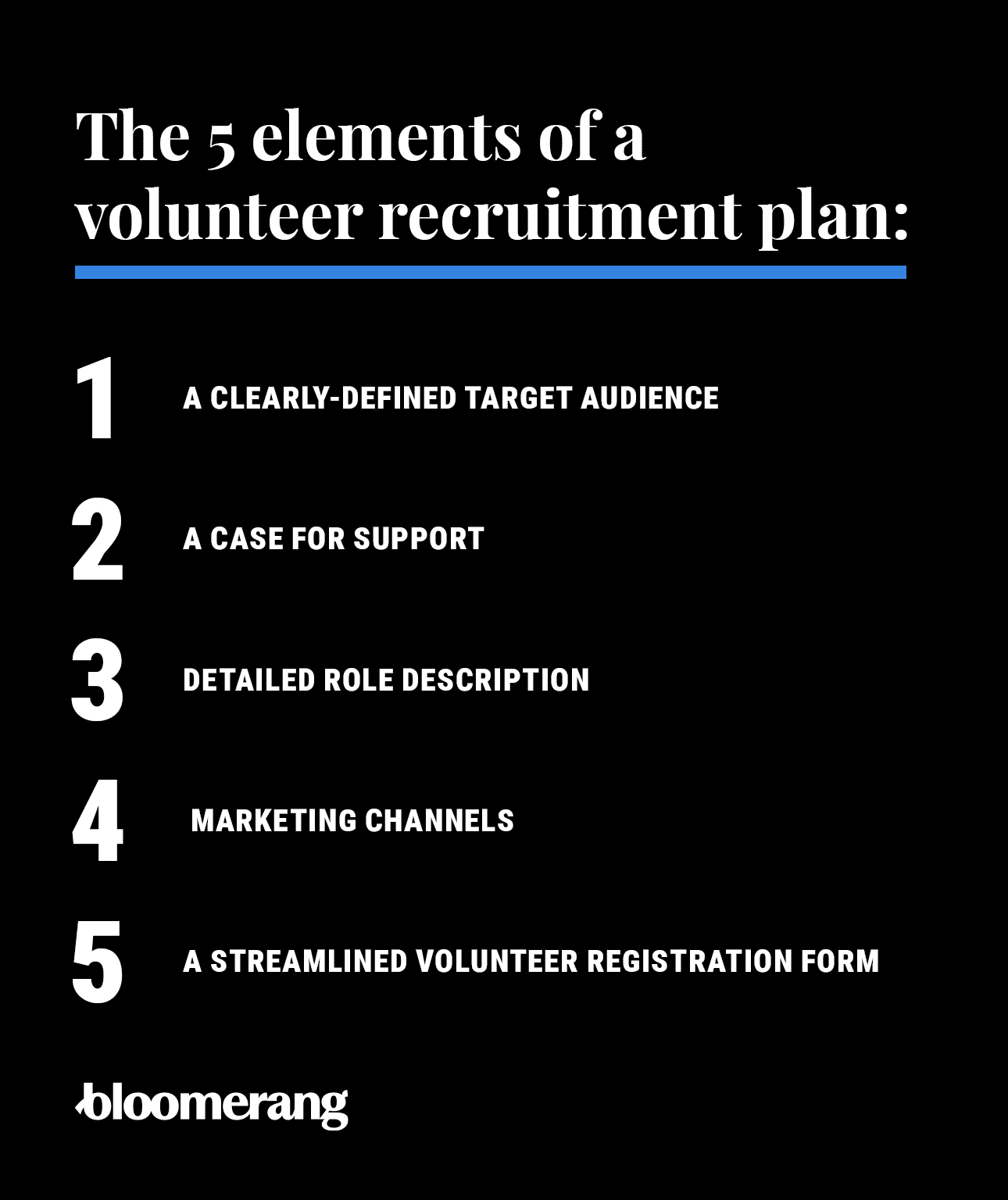
Build yours around five core elements:
19 strategies at a glance
If volunteers make up a large percentage of your nonprofit’s team, you know how important their support and dedication are in your efforts to achieve your mission. More than 75.7 million Americans volunteered in 2023, yet 26% of volunteer leaders still cite recruiting as a top challenge for their organization. Getting the right people in the right roles requires more than a sign-up form.
This guide offers insights and tactics for recruiting outstanding volunteers for your nonprofit’s events and programs—optimized for quick scanning and organized so you can jump to exactly what you need.

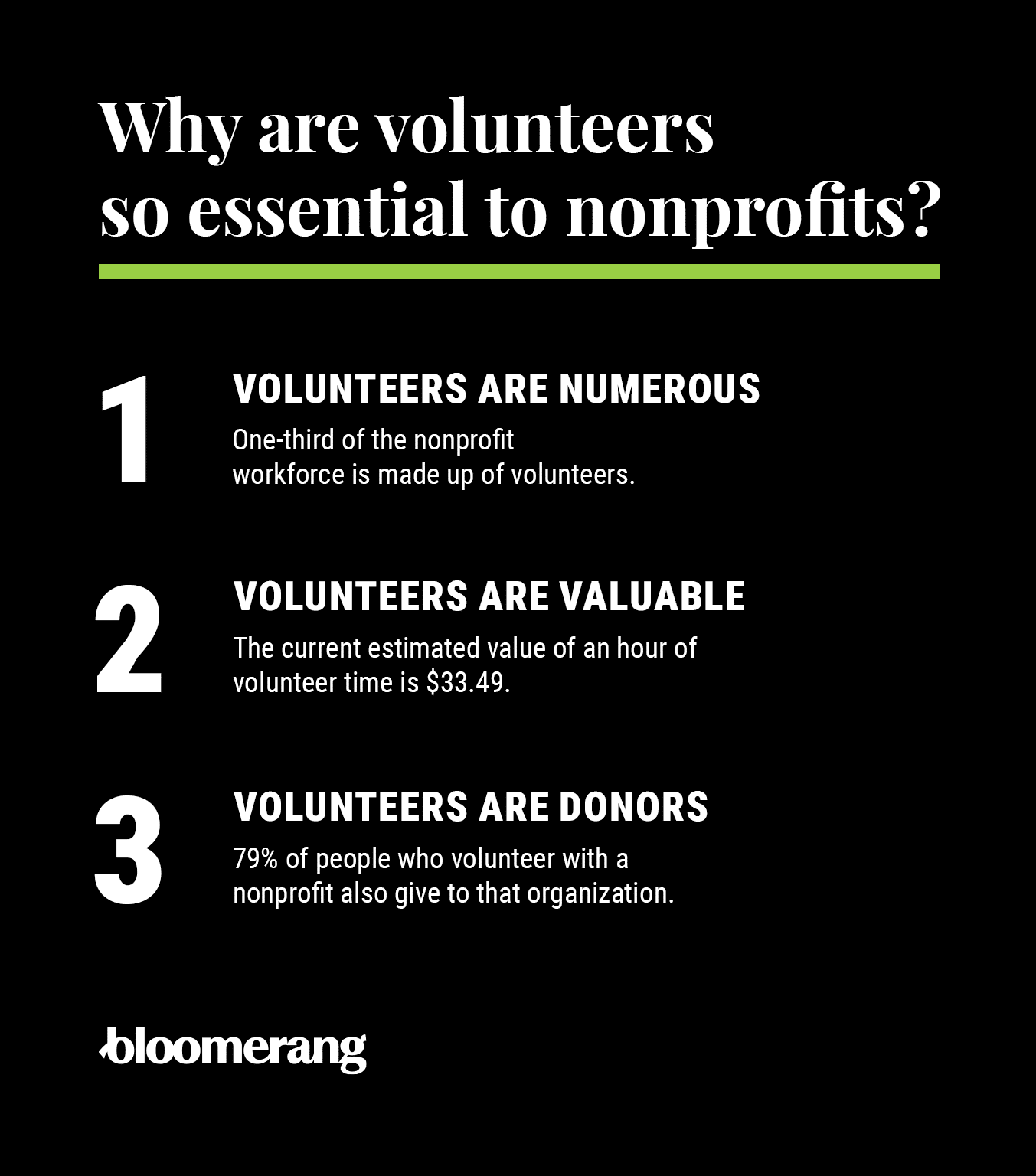
For many nonprofits, volunteers are the face of the organization. They actively engage with the community, provide services, collect donations, and work to help your nonprofit achieve its mission and goals. Recruiting reliable volunteers is essential because it delivers tangible benefits and long-term support for advancing that mission:
A volunteer recruitment plan is a strategy for attracting and recruiting new volunteers who have skills and interests that align with your nonprofit’s core needs. See the step-by-step how-to section below for a full breakdown of all five elements, including inputs, actions, outputs, and example artifacts for each.
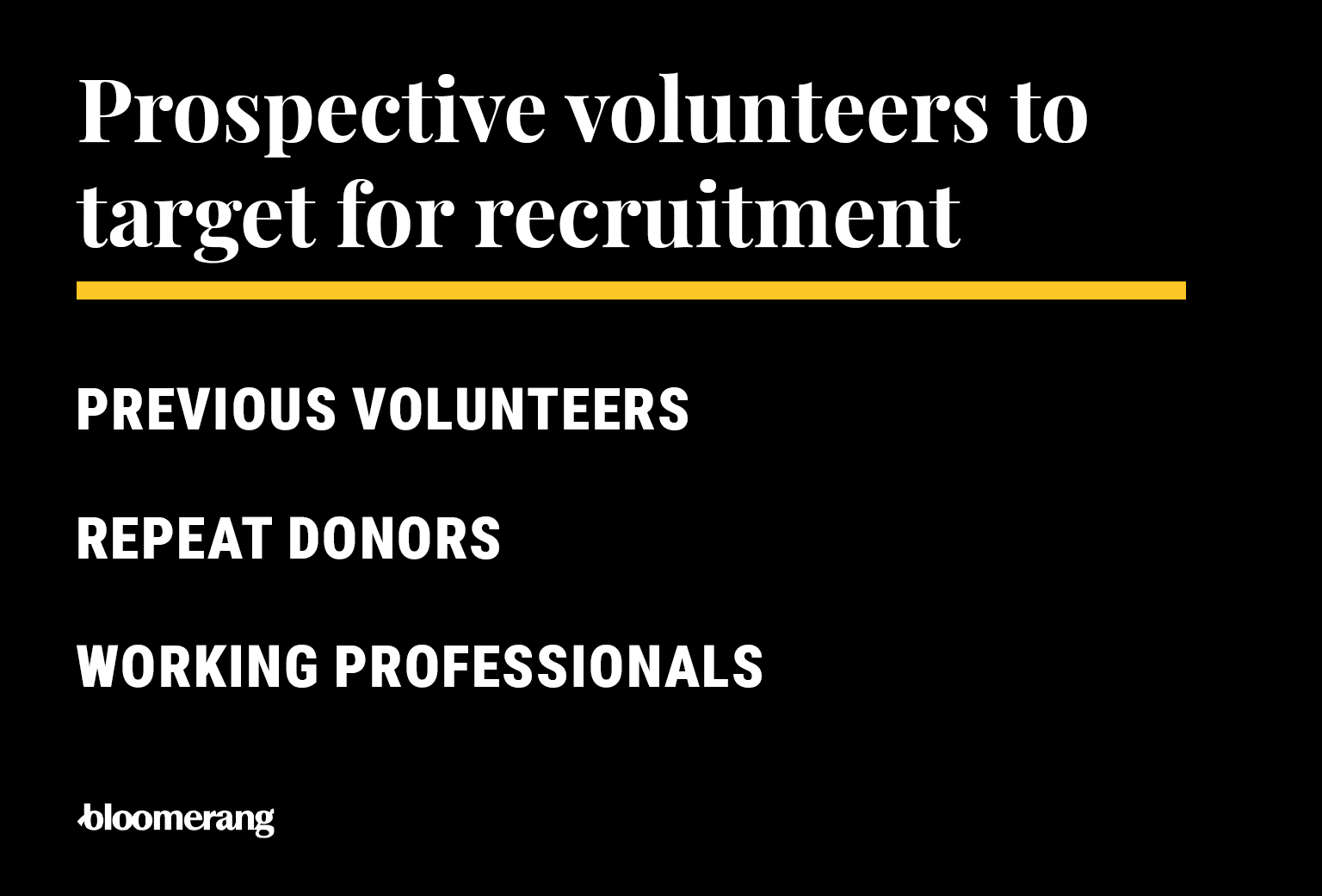
The fastest volunteer recruitment combines re-engaging lapsed volunteers with peer-to-peer outreach from your existing base:
Between these two tactics, most nonprofits see a measurable uptick in applications within days. See strategy #1 (target the right audience) and strategy #6 (peer-to-peer recruitment) for step-by-step details.
Post on at least three types of platforms:
See the full “Top 10 places to post volunteer roles” section below for a complete breakdown.
Research consistently shows that volunteers are primarily motivated by mission connection and personal recognition—not cash. The most effective incentives are:
Tangible rewards like branded merchandise or gift cards work best as a bonus on top of these—not as a primary motivator. See strategy #12 for a full incentive framework.
Treat volunteers as a distinct donor segment with a tailored cultivation pathway. The Bank of America Study of Philanthropy found that donors who also volunteer give nearly three times as much as non-volunteer donors.
The recommended process:
Bloomerang Volunteer’s two-way profile sync with Bloomerang CRM makes this seamless—volunteer data flows directly into your donor management workflow so no one falls through the cracks. For a full playbook, read how to turn volunteers into donors.
Use this section as a working framework. For each of the five core elements, you’ll find the inputs you need, the actions to take, a tangible output to aim for, and a brief example artifact to make it concrete.
Inputs: Volunteer history data, current roster demographics, role requirements, past campaign performance
Actions:
Output: Volunteer persona document with audience profiles for each major role type
Example copy — Persona one-pager
“Skilled professional volunteer — Ages 35–55, works in healthcare, motivated by community impact, available weekends, discovers opportunities via LinkedIn and email newsletters.”
Inputs: Impact data (volunteer hours logged, outcomes achieved), testimonials from current volunteers, your organization’s mission statement
Actions:
Output: A case-for-support document—the foundation for your landing page, email campaigns, and social content
Example copy — Case for support opening
“Last year, our 200 volunteers contributed 4,000 hours—worth an estimated $134,000 in time. More than the math: they helped 800 families access food, housing, and support. Here’s what that meant to them.” [Testimonial block]
Inputs: Manager input on each role’s tasks, time commitment, skills required, physical requirements, and success criteria
Actions:
Output: A library of finalized role descriptions ready to publish across all channels
Example copy — Finished role description
“Food pantry volunteer — Saturdays, 9 a.m.–12 p.m. You will help families access groceries every week—making a direct impact every single shift. No experience required. Just bring reliability and comfortable shoes. [Sign up here]”
Inputs: Source data on how current volunteers found you (ask them), budget for paid promotion, staff capacity per channel
Actions:
Output: A channel shortlist with posting cadence and owner for each
Example copy — Channel plan snapshot
Email: bi-weekly | Owner: volunteer coordinator
Facebook: 3x/week | Owner: communications team
VolunteerMatch: updated monthly | Owner: volunteer coordinator
LinkedIn DMs: as-needed for skilled roles | Owner: programs director
Inputs: A volunteer management platform to track applications, conversion rates, and source data—a defined set of weekly KPIs
Actions:
Output: A recruitment dashboard showing source data, conversion rates, and cost per volunteer
Example copy — Recruitment funnel snapshot
“Of 150 form visits last month, 62 completed the application (41% conversion rate). Top sources: email (38%), Facebook (29%), VolunteerMatch (22%). Lowest-converting channel: X/Twitter (4%). Recommendation: reallocate X budget to email.”
Knowing exactly who you’re recruiting before you launch saves time and dramatically improves the quality of applicants.
How to do it
Example copy — Re-engagement email to lapsed volunteers
Subject: We’ve missed you, [First Name]
Hi [First Name], it’s been a while since we’ve seen your face at [Program Name], and we’re hoping to change that. We have new [role] openings that match your skills perfectly—shifts available [days/times]. Ready to jump back in? [Sign up here]
A clear, specific role description is the single highest-leverage thing you can do to attract the right volunteers and reduce no-shows.
How to do it
Example copy — Role description snippet
“Food pantry volunteer — Saturdays, 9 a.m.–12 p.m. You’ll help stock shelves and distribute groceries to families in our community—making a direct impact every single week. No experience required. Just bring a positive attitude and comfortable shoes. Ready? [Sign up here]”
Informational sessions turn curious prospects into committed volunteers by giving them a live, personal preview of what it’s really like to show up for your mission.
How to do it
Example copy — Informational session invite email
Subject: Come see what we’re about
We’d love to meet you. Join us for a 45-minute info session on [Date] at [Time]—virtual or in person, your choice. Learn about our mission, explore open roles, and get your questions answered. [Reserve your spot]
A shorter, smarter form gets more completions—and the right fields let you match volunteers to roles automatically.
How to do it
Example copy — Form intro copy
“It only takes two minutes to sign up. Tell us a little about yourself, and we’ll match you with the right opportunity.”
Integrating your website, email, and social media into a unified digital strategy typically yields better results than relying on any individual platform.
How to do it
Example copy — LinkedIn DM to a prospective skilled volunteer
Hi [Name], I noticed your background in [Skill] on LinkedIn. We’re looking for volunteers at [Org] who can help with [Role]—it’s a [X-hour] commitment on [days]. Interested in learning more? Happy to send over the details.
Your current volunteers are your most credible recruiters—one personal ask from a peer is worth ten cold posts.
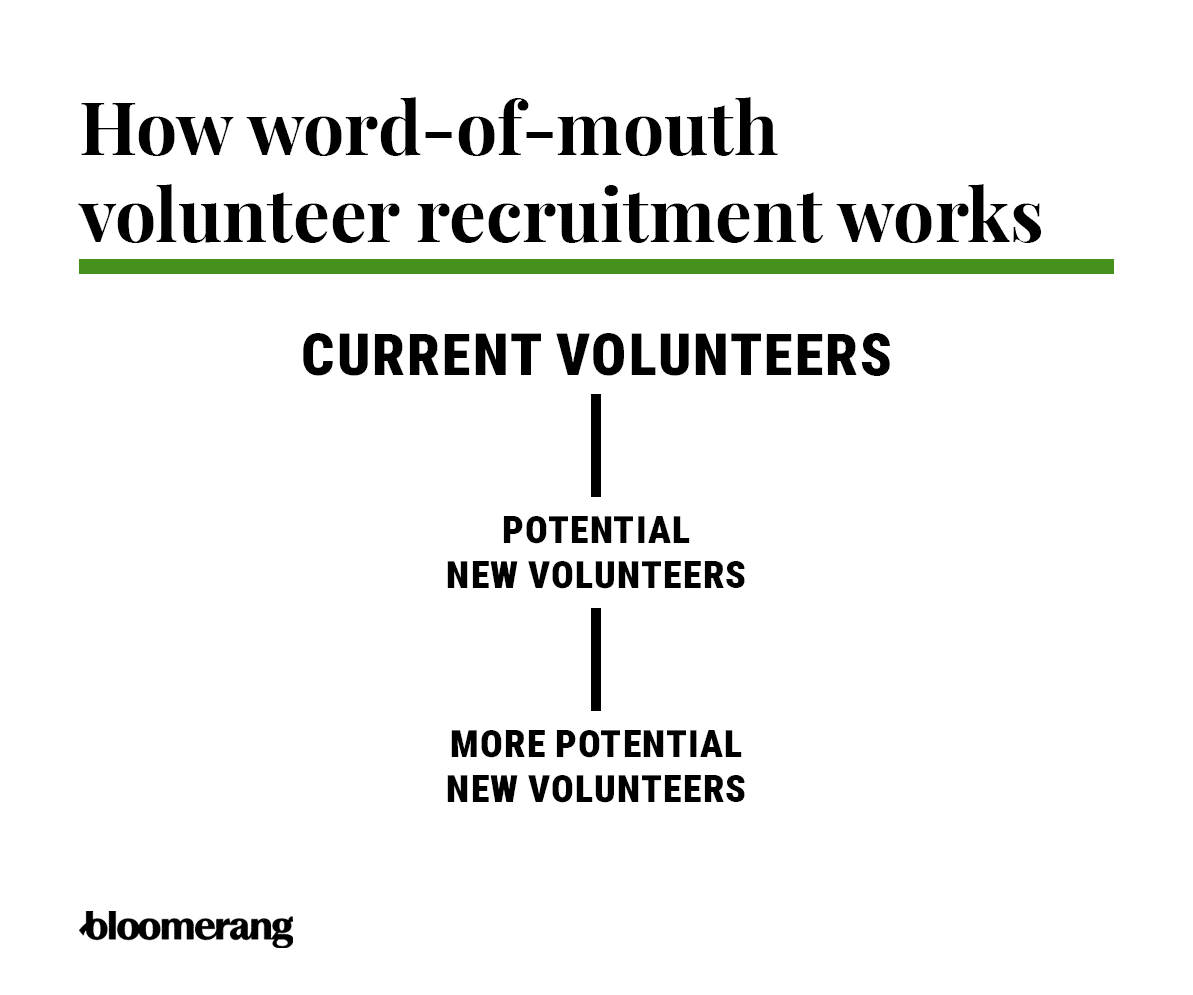
How to do it
Example copy — Shareable social post for volunteers to use
“I volunteer with [Org Name] and it’s one of the best parts of my week. They’re looking for more people—especially [role type]. If you’ve got [X hours] and want to make a real difference locally, here’s the link: [URL]”
Corporate volunteer programs give you access to pre-motivated, often grant-eligible volunteers in bulk—and building even one business partnership can fill your roster for a season.
How to do it
Example copy — Corporate outreach email
Subject: Bring your team. Make a real impact.
Hi [Name], [Company] and [Org] share a commitment to [shared value]. We’d love to host your team for a half-day volunteer event. We handle all the logistics—you just show up and make a difference. Can we set up a quick 15-minute call? [Book a time]
For context: the Deloitte Volunteerism Survey found that 77% of companies believe volunteerism is essential to employee wellbeing—giving you a strong pitch for any CSR conversation. See our guide on corporate volunteering platforms for a list of tools that connect nonprofits to corporate volunteers.
Partnering with civic clubs, professional associations, and faith communities gives you a warm referral pipeline that self-renews every year.
How to do it
Example copy — Outreach email to a professional association
Hi [Advisor Name], I’m [Name] from [Org]. We work with local [cause] and we’re looking for partners who can help us [specific need]. Members of [Association] would bring incredible expertise—and earn [volunteer hours / CLE credits / etc.] in return. Could we find 30 minutes to explore what this could look like?
Posting on dedicated volunteer platforms puts your open roles in front of an audience that is already motivated to get involved—without requiring you to build that audience yourself.
How to do it
Example copy — Listing description opener (for any platform)
“[Org Name] is looking for [role] volunteers to [specific impact statement]. Time commitment: [X hours/week or per shift]. Location: [city or remote]. No experience necessary—just [one quality]. [Apply here].”
A well-pitched local media story puts your volunteer needs in front of thousands of community members you can’t reach through your own channels.
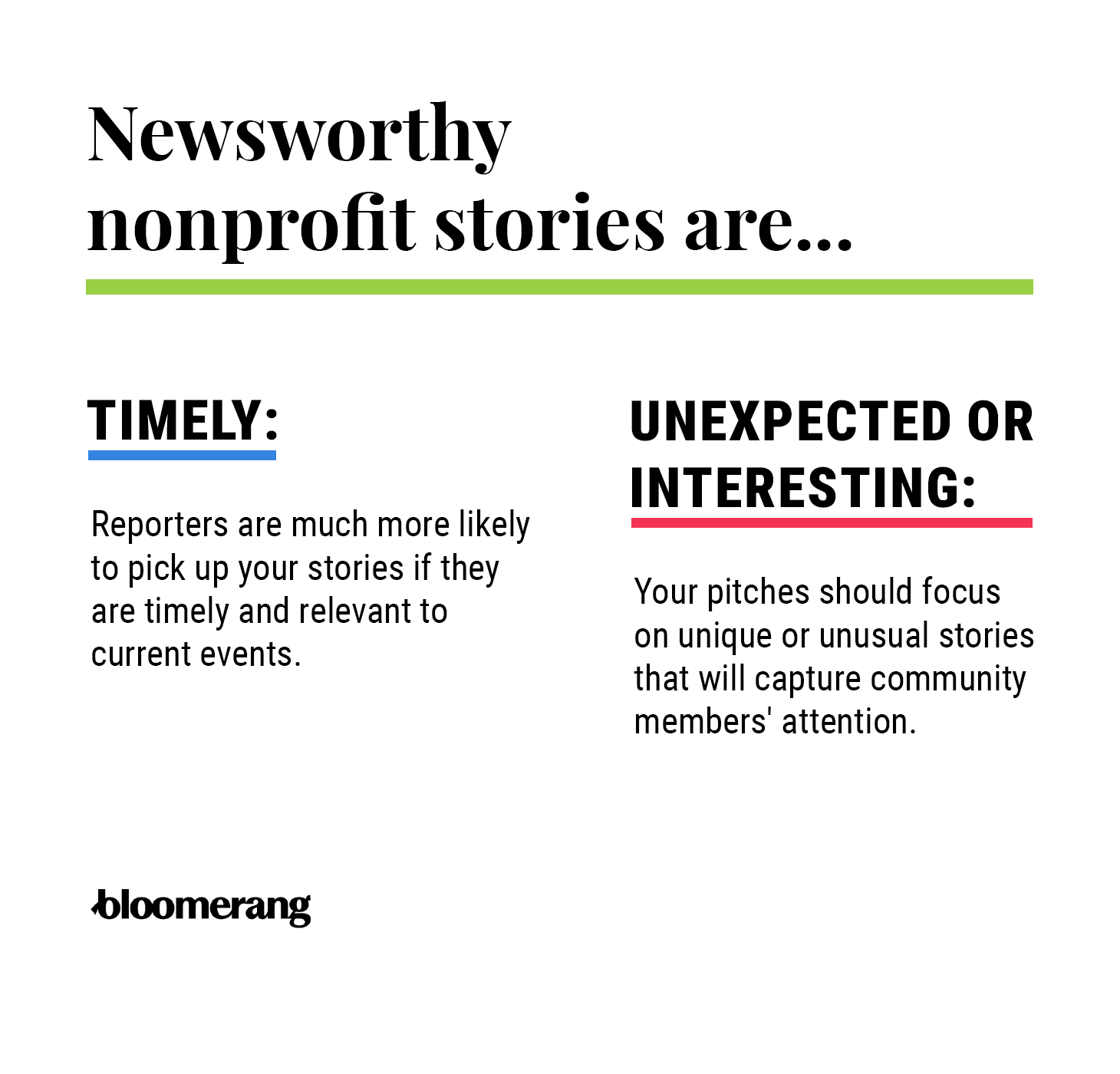
How to do it
Example copy — Press pitch subject line and opener
Subject: 100-year-old volunteer still shows up every week. Want to meet her?
Hi [Reporter], I have a story your audience will love. [Volunteer Name], age 100, has volunteered at [Org] every [day] for [X years]. She’s part of our 200-person volunteer team that [mission impact]. I’d love to connect you for a short interview before our next [event]. Interested?
Adding competition and milestones to your volunteer program keeps current volunteers engaged longer—and makes it something worth telling others about.
How to do it
Example copy — Volunteer challenge announcement email
Subject: The [Fall Challenge] starts now.
This October, we’re tracking who can log the most volunteer hours. Top three finishers win [prizes]. Everyone who hits 20 hours gets [recognition]. Ready? Your hours start counting October 1. [See the leaderboard]
The right incentives—especially ones that feel personal and mission-connected—significantly improve both new volunteer sign-ups and long-term retention.
How to do it
Example copy — Volunteer appreciation social post
“Meet [Name]. She’s volunteered 150 hours with us this year—and her commitment means [specific impact]. We couldn’t do this without people like her. Tag someone who gives their time.”
Removing physical, logistical, and language barriers to volunteering expands your potential pool and helps you build a more representative, resilient team.
How to do it
Example copy — Accessible opportunity announcement
“Can’t make it to our site? No problem. We have volunteer roles you can do from anywhere—phone banking, social media sharing, or remote data entry. Sign up today and make an impact from home. [See virtual roles]”
Volunteers who feel genuinely valued stay longer, recruit others, and are far more likely to become donors.
How to do it
Example copy — Post-shift thank-you email
Hi [Name], thank you for showing up on [day]. Because of your [X hours], we were able to [specific outcome]. That’s not a small thing—it’s the whole reason we do this. We’ll see you [next shift date]?
For a comprehensive appreciation playbook including event ideas, recognition frameworks, and messaging templates, see our ultimate volunteer appreciation guide.

Creating a visible path from volunteer to leader gives ambitious supporters a reason to stay—and gives your program a self-sustaining bench of trained coordinators.
How to do it
Example copy — Leadership program announcement
“Volunteering since [year]? You might be ready for the next level. We’re launching [Program Name]—a training track for experienced volunteers ready to help lead shifts and onboard new team members. Applications open [date]. [Learn more]”
Regular, targeted feedback surveys help you fix the friction points that silently drive volunteers away—and create a program people actively recommend to others.
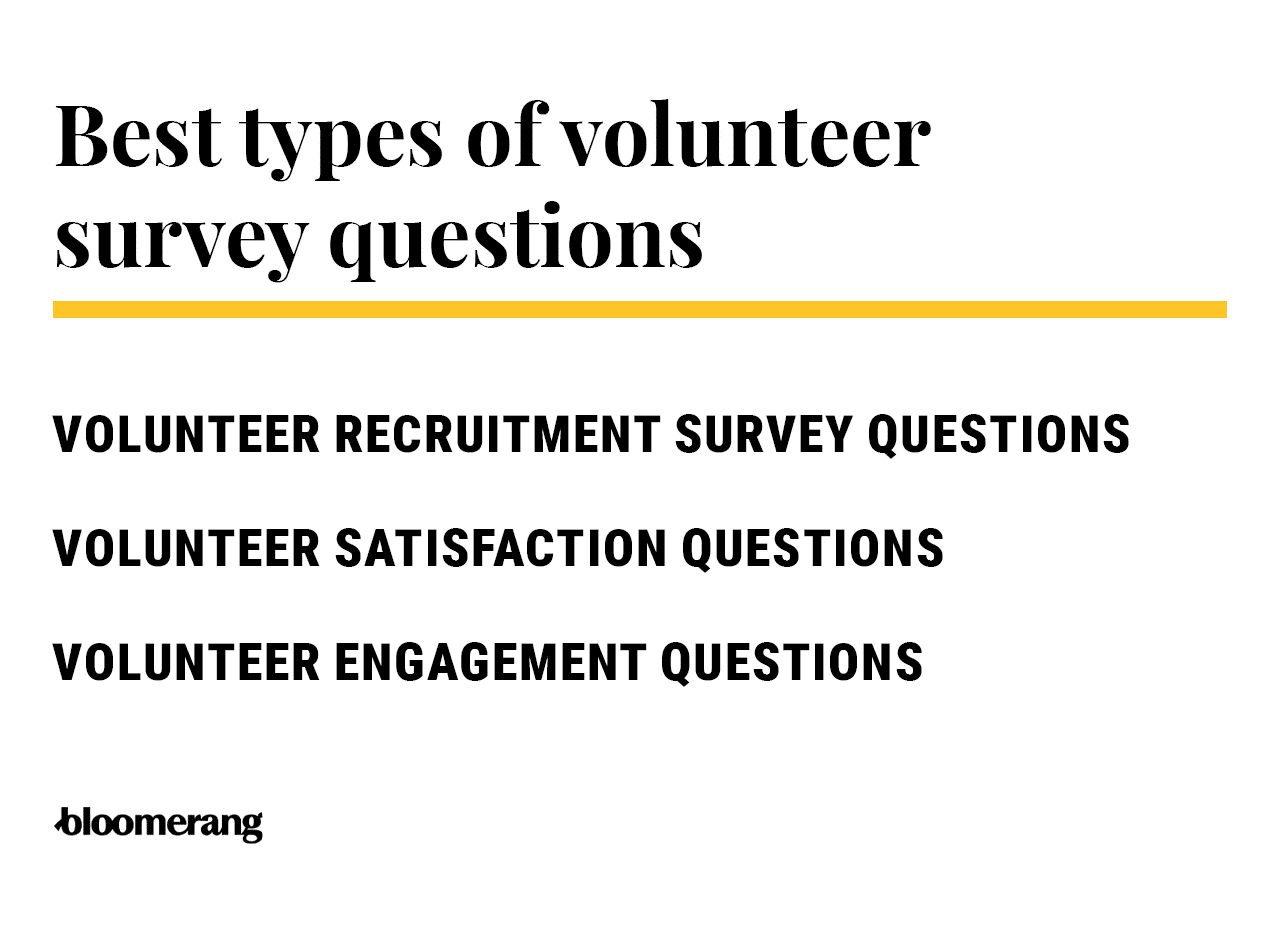
How to do it
Example copy — Post-shift survey invite
“We want to hear from you. How did your shift go today? It only takes two minutes—and your feedback directly shapes how we run this program. [Take the survey]”
For ready-made survey templates and the questions volunteers actually answer, read our guide on volunteer surveys: tips and best questions to ask.
Rigid timelines and shift structures are one of the top reasons potential volunteers don’t follow through. Flexibility removes the biggest barrier between interest and action.
How to do it
Example copy — Flexible opportunity social post
“Busy schedule? Same. That’s why we have volunteer shifts that fit around your life—weekends, evenings, even fully remote options. Two hours a week can change everything. [See what fits]”
Teenagers and college students are an often-overlooked pipeline of motivated, high-hour volunteers—and the organizations that meet them where they are build loyalty that lasts decades.
How to do it
Example copy — Email to a school service-learning advisor
Hi [Advisor Name], I’m [Name] from [Org]. We’re looking for motivated students who need community service hours this [semester/year]. We can accommodate groups and individual placements—and we provide a verification letter for each completed hour. Could we connect for 15 minutes to see if this is a good fit?
The right volunteer management platform removes administrative drag from recruitment so your team spends time building relationships instead of chasing spreadsheets.
How to do it
Example copy — Internal pitch for volunteer software to leadership
“Right now, [X hours/month] go to manual volunteer scheduling and follow-up. A platform like Bloomerang Volunteer automates this—giving [Coordinator Name] time back for the relationship-building that actually drives retention. Estimated time savings: [X hours]/month.”
Ready to evaluate your options? Read our guide to volunteer management software for a side-by-side comparison of the top platforms, or schedule a Bloomerang Volunteer demo to see how it works for your specific program.
Use this matrix to quickly evaluate which strategies fit your team’s capacity, budget, and goals.
| # | Strategy | Time required | Skill level | Cost | Expected impact | Best for | Primary metric |
|---|---|---|---|---|---|---|---|
| 1 | Target the right audience | 2–4 hrs setup | Intermediate | Free | High | All orgs | Applicant-to-role-fit rate |
| 2 | Write well-crafted role descriptions | 1–2 hrs/role | Beginner | Free | High | All orgs | Application completion rate |
| 3 | Host informational sessions | 3–5 hrs/month | Intermediate | Low ($0–$50) | Medium | Mid-to-large orgs | Attendee-to-applicant rate |
| 4 | Craft a simple application form | 2–3 hrs setup | Beginner | Free | High | All orgs | Form completion rate |
| 5 | Optimize digital promotion | Ongoing | Intermediate | Low–medium | High | All orgs | Landing page conversion rate |
| 6 | Peer-to-peer recruitment | Ongoing | Beginner | Free | Medium | All orgs | Referral sign-up rate |
| 7 | Corporate volunteerism | 5–10 hrs setup | Intermediate | Free | High | Mid-to-large orgs | Corporate partners active/quarter |
| 8 | Community org partnerships | 5–10 hrs setup | Intermediate | Free | Medium–high | All orgs | Partner referrals/month |
| 9 | Promote on volunteer sites | 1–2 hrs setup | Beginner | Free–low | Medium | All orgs | Applications from listing sites |
| 10 | Connect with local media | 3–5 hrs/pitch | Advanced | Free | Medium | Community-focused orgs | Press mentions & resulting inquiries |
| 11 | Gamify your program | 10+ hrs setup | Advanced | Low–medium ($50–$200) | Medium | Large programs | Avg hours/participant per campaign |
| 12 | Offer volunteer incentives | 2–3 hrs planning | Beginner | Medium ($100–$500) | Medium | All orgs | Volunteer retention rate |
| 13 | Make opportunities accessible | 5–10 hrs setup | Intermediate | Low–medium | High | Urban/suburban orgs | % accessible opportunities offered |
| 14 | Show volunteer appreciation | 2–4 hrs/quarter | Beginner | Low ($50–$200) | High | All orgs | Volunteer retention rate (post-shift) |
| 15 | Offer leadership pathways | 10+ hrs setup | Advanced | Low | High | Mid-to-large programs | Volunteers promoted to leader/year |
| 16 | Gather volunteer feedback | 1–2 hrs setup | Beginner | Free | Medium | All orgs | Survey response rate & NPS |
| 17 | Offer flexible opportunities | 5–10 hrs setup | Intermediate | Low | High | Busy professionals | % of shifts filled within 48 hrs |
| 18 | Engage young volunteers | 5–10 hrs setup | Intermediate | Low | High | Education-adjacent orgs | Youth % of total volunteer roster |
| 19 | Use volunteer management software | 10+ hrs setup | Advanced | Medium–high | Very high | Mid-to-large orgs | Cost per volunteer acquired |
Not all volunteer boards are created equal. Here’s how to choose the right mix of national boards, local hubs, campus platforms, and neighborhood channels for your open roles.
| # | Platform | Type | Best for |
|---|---|---|---|
| 1 | Idealist | National | Skilled/professional volunteers, career-changers, all cause areas. Free to post. ~2M monthly visits. |
| 2 | VolunteerMatch | National | Broad geographic reach, 15M+ registered volunteers, strong for recurring in-person roles. |
| 3 | Points of Light Engage | National | Virtual and skills-based roles, free API to syndicate listings to partner platforms automatically. |
| 4 | Galaxy Digital | National / Platform | Mid-to-large orgs that want built-in matching, tracking, and reporting alongside their postings. |
| 5 | Taproot Plus | National — skills-based | Pro-bono professional skills (legal, marketing, finance, tech), connects you to corporate skilled volunteers. |
| 6 | Nextdoor | Neighborhood | Hyperlocal in-person roles where proximity matters (community gardens, food pantries, clean-ups). |
| 7 | United Way / local volunteer centers | Local | City and regional nonprofits, hubs actively market your opportunities to their local subscriber base. |
| 8 | HandsOn Network affiliates (e.g., Hands On Atlanta, LA Works) | Local | Urban orgs needing bulk event-day volunteers, affiliates recruit actively through their own channels. |
| 9 | Campus service-learning offices + GivePulse | Campus | Youth volunteers who need service hours, contact the coordinator directly—they maintain internal boards. |
| 10 | Facebook Groups + Nextdoor community boards | Neighborhood / Social | Informal, drop-in, or short-term opportunities, effective for last-minute recruitment via social proof. |
Your volunteers make your mission possible—they’re the ones showing up, rolling up their sleeves, and turning your organization’s goals into real-world outcomes. That’s why investing in the right recruitment strategy for each program pays off so significantly: the time you spend crafting a thoughtful plan translates directly into reliable volunteers who stick with your organization for years.






Comments